Race to the End: The World, the Flesh, and the Devil (1959)
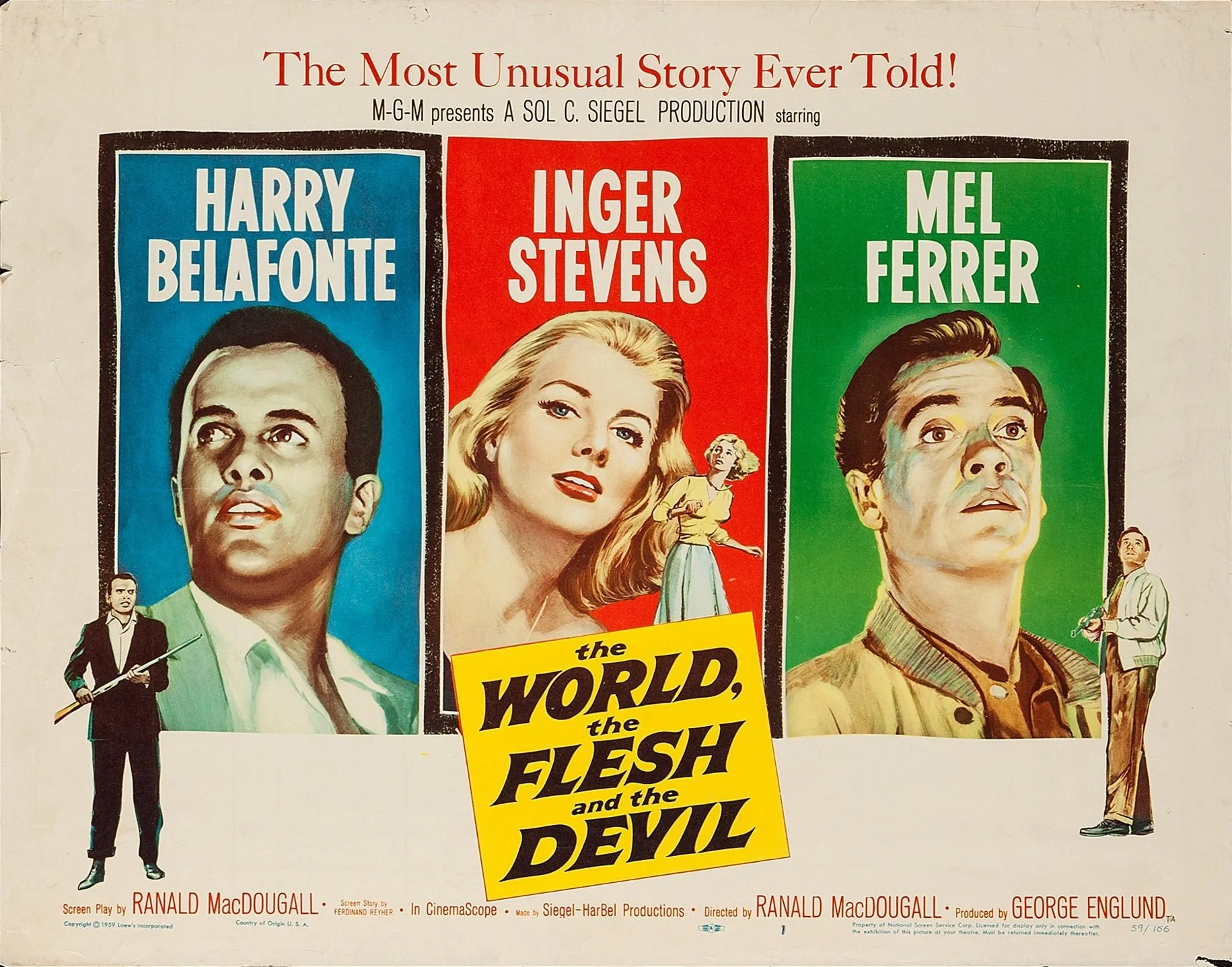
Original poster art
We are back in the realm of classic science fiction, featuring a movie in large part about race and released smack dab in the middle of the modern civil rights movement. The World, the Flesh, and the Devil (1959) straddles two decades in content and tone: the tidy and traditional 1950s and the status quo-challenging 1960s. This may be an oversimplification of the times, but it nonetheless captures their sensibilities to a large extent. This is a quiet, character-driven film, and we are excited to dive into it.
Sole Survivor?
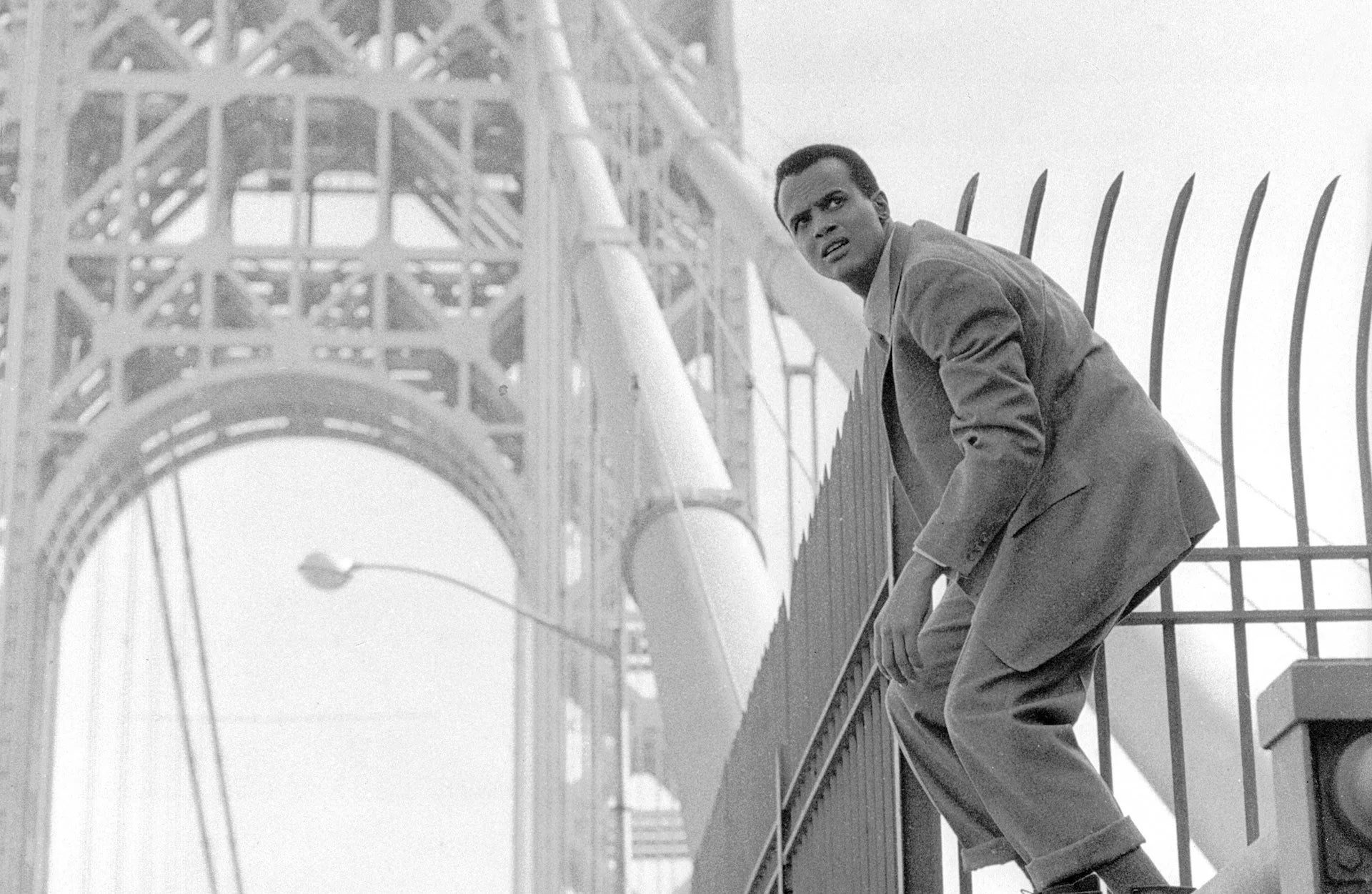
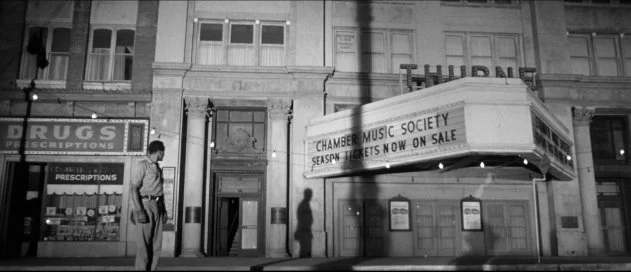
Mining engineer Ralph Burton (Harry Belafonte) emerges from a collapsed western Pennsylvania coal mine where he was trapped for five harrowing days. His elation quickly gives way to disorientation as it seems everyone on the surface has vanished. The mining offices are abandoned and the nearby municipality is a ghost town—life seems to have abruptly stopped. Ralph, a Black man, drives east towards New York to search for signs of life, only to find that once bustling city eerily empty and still.
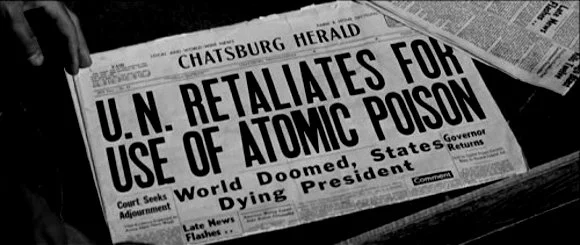
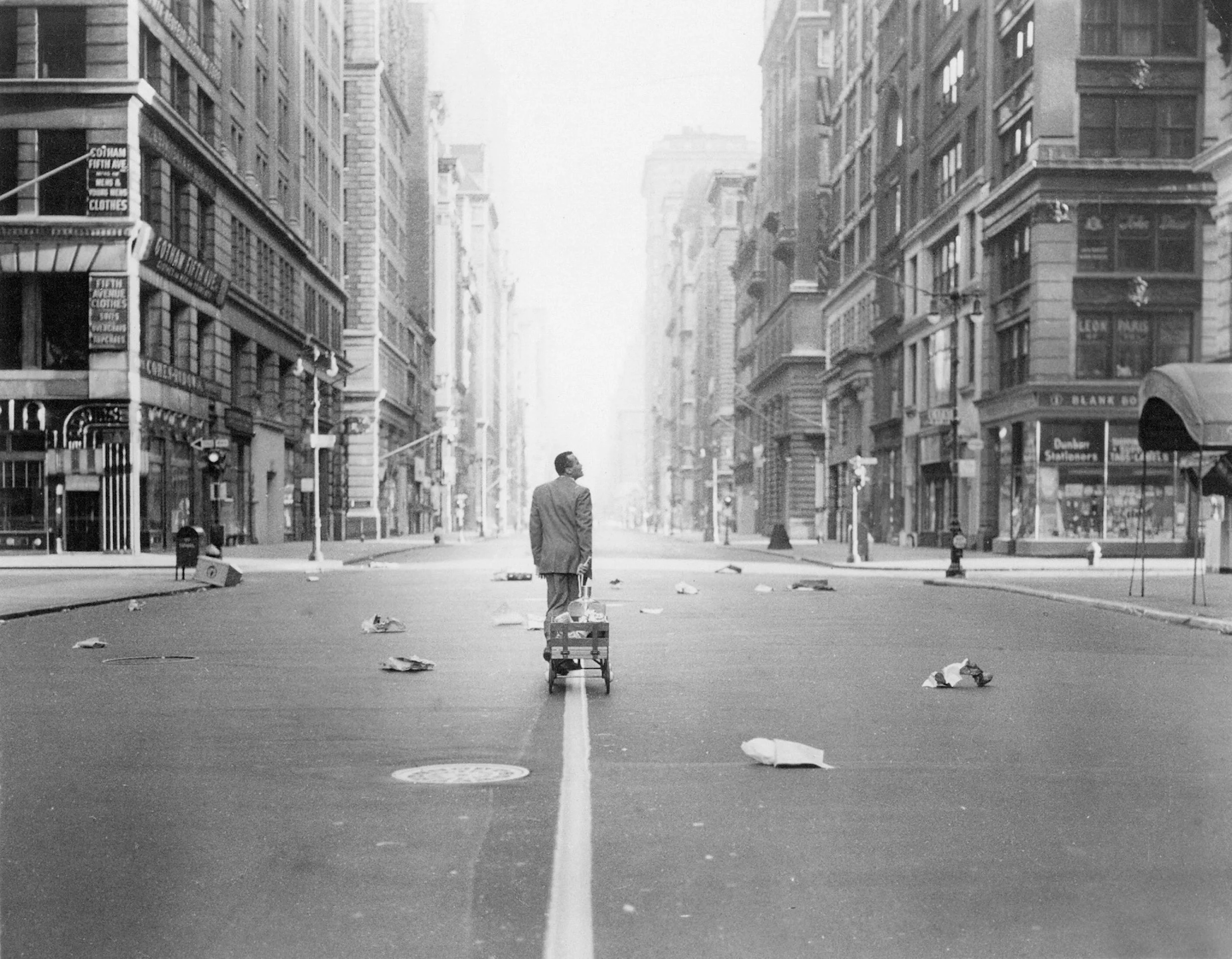
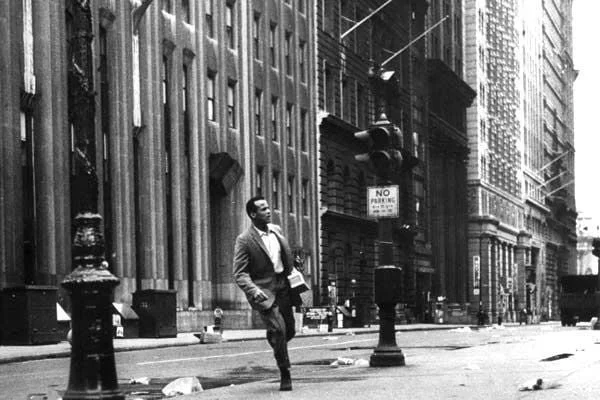
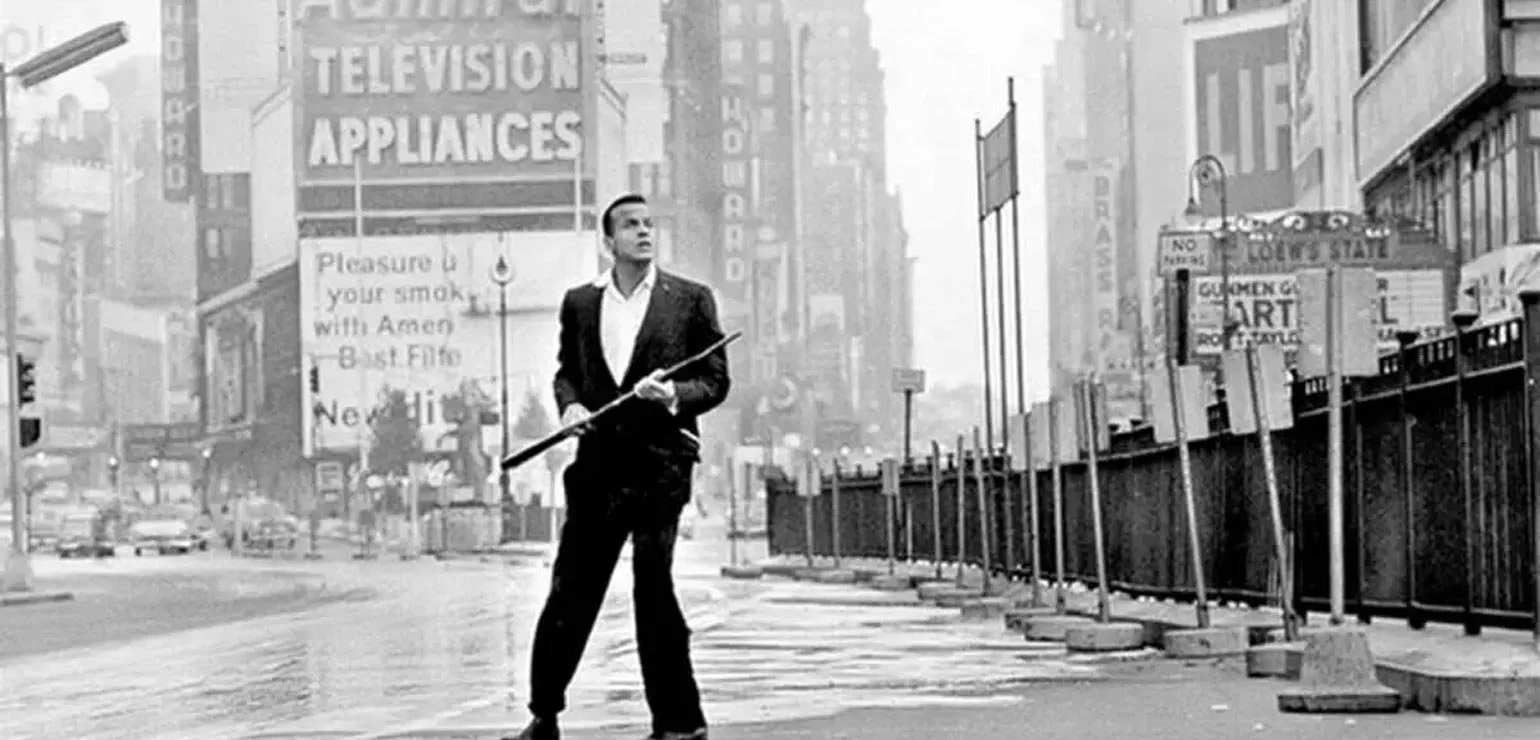
Our hero has his jovial spirit tested as he wanders Manhattan’s streets pulling a wagon of supplies and calling out in frustration and disbelief. He eventually learns through newspapers and a recorded radio broadcast that World War III broke out while he was underground. The combatants released nuclear isotopes into the upper atmosphere killing most of humanity. We also learn that the air remained lethal for five days, implying that anyone fortunate to be hunkered down or sealed off somewhere stood a chance to survive.
Deciding to make the best of his post-apocalyptic new normal, Ralph busies himself by gathering life essentials and sets himself up with some creature comforts in a high-rise apartment. Quite handy and resourceful, he also jerry-riggs a new power source to generate electricity. Without much to do, he takes to collecting artwork and other items he presumes will eventually represent artifacts from the old world, and he occasionally picks up a guitar and sings for his own entertainment—this is Harry Belafonte, after all.
Ralph & Sarah
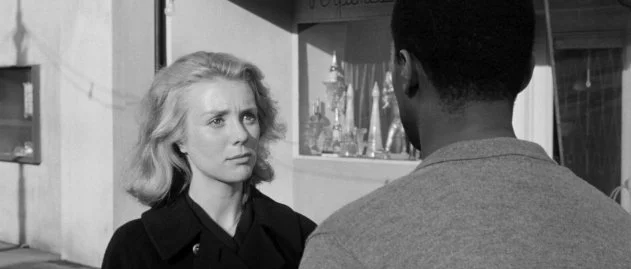
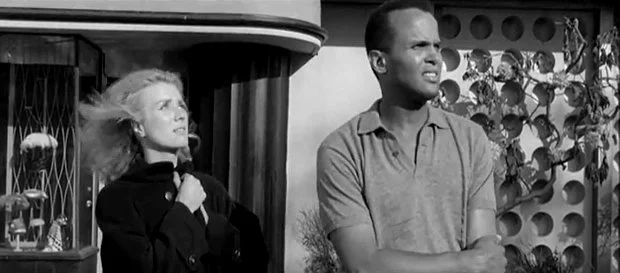
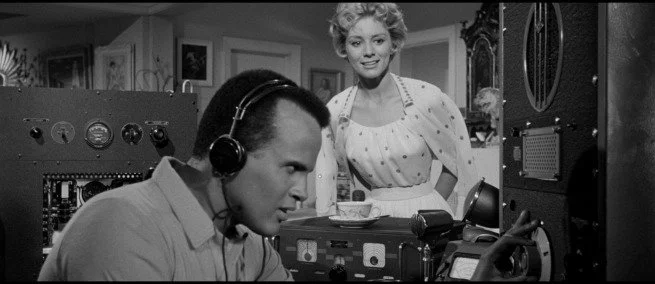
Just as Ralph is settling into this solitary new life, he meets a 21-year-old white woman by the name of Sarah Crandall (Inger Stevens). Sarah, who had been spying on Ralph for some time, wears her heart (and vulnerability) on her sleeve, telling her new acquaintance outright that she needs him in order to survive. The two hit it off from the start, developing a platonic relationship that provides companionship and mutual support. They take turns hosting lunch in their respective apartments, celebrate eachothers’ birthdays, and banter playfully like old friends. Ralph even manages to get the phones working and begins a daily shortwave radio transmission to reach other possible survivors, ultimately picking up a garbled response that confirms his hopes.
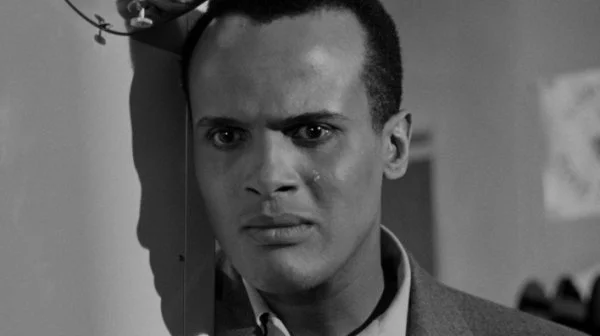
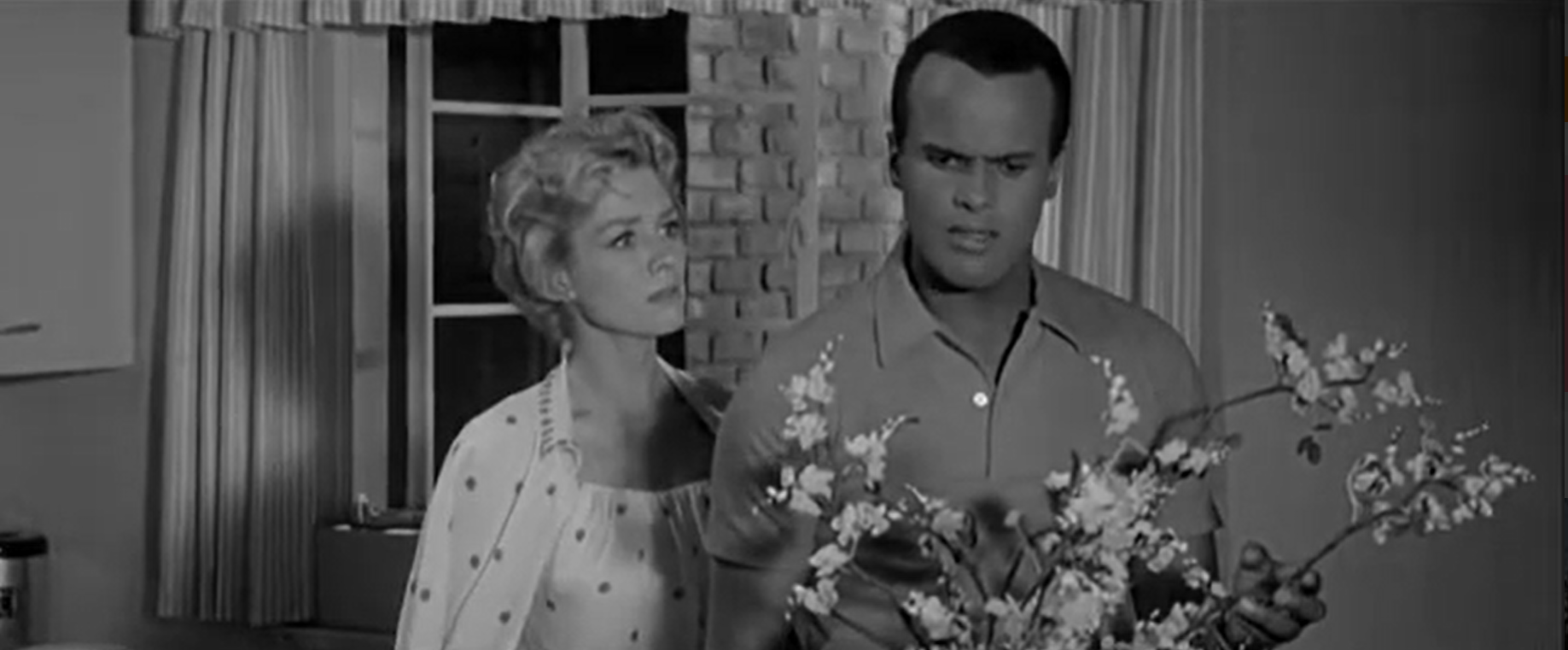
Our duo’s relationship hits a snag when Sarah suggests moving into Ralph’s building. Triggered by the implications of having a Black man and a white woman seemingly cohabitate—even in a world devoid of other humans—leads Ralph to rebuff Sarah and pursue a tense but necessary dialogue about race and the world that was. Ralph’s conflicted emotions suggest that the psychologic imprint of deeply rooted institutional racism lingers even as those institutions theoretically no longer exist. The scene is made even more dynamic by the fact that the two have developed some romantic chemistry.
Three’s a crowd
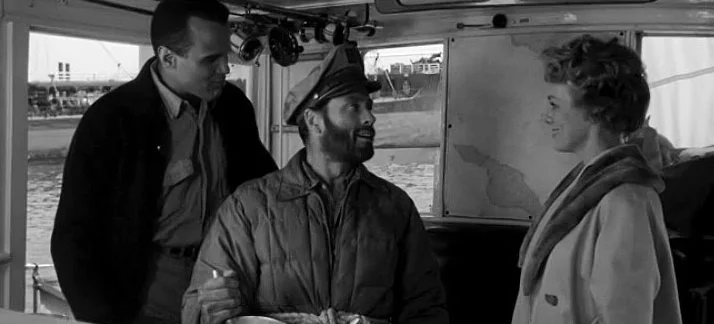
Life in New York becomes infinitely more complicated with the arrival of Ben Thacker (Mel Ferrer). Traveling up the quiet Hudson River, Ben barely reaches Manhattan in a small boat before collapsing from exhaustion. He is nursed back to health by Ralph and Sarah, ultimately expanding their community to three.
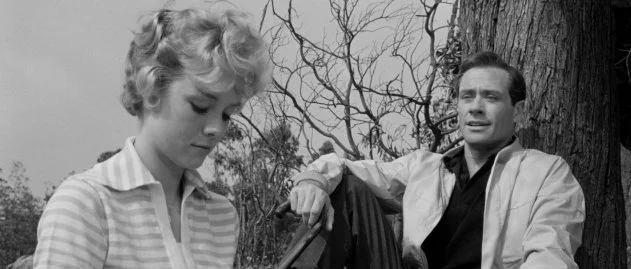
A bit older than Ralph, Ben is a charming and seemingly easy-going white man who lost his wife and two kids to the apocalypse. While the trio get along well enough, the dynamic shifts dramatically as Ralph keeps his distance, almost hoping the other two will pair up. Initially diplomatic about the situation, Ben becomes increasingly covetous and more aggressive about wanting to be with the only woman in town. Meanwhile Sarah is somewhat ambivalent about Ben, turned off by his increasingly overt and crude overtures, while equally frustrated at Ralph for his hesitance to follow through on the love he has already professed.
Resentments grow among this quasi-love triangle and some type of clash seems inevitable. The climax might surprise you.
My two cents
Even those with a casual familiarity of mid-century U.S. history will recognize some of the issues of the day permeating The World, the Flesh, and the Devil, including Cold War-era fears of a nuclear holocaust and the legacy of racism run up against the modern civil rights movement. Neither topic is discussed outright, but the imprint is certainly there.
Star Harry Belafonte was a longtime activist for global racial justice and basic dignity and fundamental rights of Black Americans pre-and-post-Jim Crow. He marched, fundraised, and organized with Martin Luther King Jr. and many others over the decades. To his credit, he also refused to perform in the south between 1954 and 1961 when it might have been easier and more profitable to do so. As an artist he is best known for his Caribbean/Calypso-inspired music, though he also performed folk, blues, jazz, R&B, and Broadway standards with his easy, breezy vocal style. As an actor and activist, Belafonte ran into resistance artistically and on the advocacy front but continued to fight for the cause undeterred. He passed away in 2023 at the age of 96.
Belafonte’s Ralph Burton exudes charm, an inherent kindness, and even a sense of fun, all of which must coexist with his inner turmoil brought on by Sarah’s arrival. Ralph, we suspect, was attempting to move on from a society where prejudice and codified racism was the way of the world, and Sarah’s presence complicates those efforts. While the two become close friends and move closer toward a romantic relationship, the idea of their coupling is so daunting to Ralph that he refuses to entertain it despite his professed love for Sarah.
There is a particularly charged scene where Sarah asks Ralph to cut her hair. The prospect of this turns Ralph into a bundle of nerves, angst, and fear that extends well beyond his giving a bad haircut; it is an emotionally blistering scene that both Belafonte and Stevens carry off beautifully.
Inger Stevens’ Sarah resonates as young, privileged, and naïve yet her performance is anything but one dimensional. She is flawed and immature, and even drops an inferred yet indirect racist remark that stings Ralph. At the same time Sarah openly admits she doesn’t have it all figured out. I do not typically include longer blocks of dialogue excerpts, but I think these exchanges really capture the duo’s dynamic:
Sarah: It’s taking you too long to accept things, Ralph. This is the world we live in. We’re alone and I know what you are, if that's what you're trying to remind me.
Ralph: That's it alright. If you're squeamish about words, I'm colored. And if you face facts, I'm a negro. And if you're a polite southerner, I'm a negrah. And I'm a nigger, if you're not.
Sarah: I'm none of those things, Ralph!
Ralph: A little while ago you said you were: "Free, white, and 21." That didn't mean anything to you, just an expression you've heard for a thousand times. Well to me it was arrow in my guts!
Sarah: Ralph, what do I say, Help me! I know you, you're a fine, decent man. What else is there to know?
Ralph: That world that we came from, you wouldn't know that. You wouldn't even know me! Why should the world fall down to prove I'm what I am and that there's nothing wrong with what I am?
Mel Ferrer plays our ostensible villain Ben Thacker with a volatile blend of charisma, male chauvinism, and a perceptive if cynical take on human nature. Ben professes to Ralph that he actually has no issue with his race and in a sense, we believe him. As he sees it, they have only one problem: there are two of them and one of “her.” Of course, while the majority of humanity is dead, sexism is still alive and well, with Sarah subject to Ben’s mansplaining and bristling at the fact that she doesn’t seem to have a say in her future.
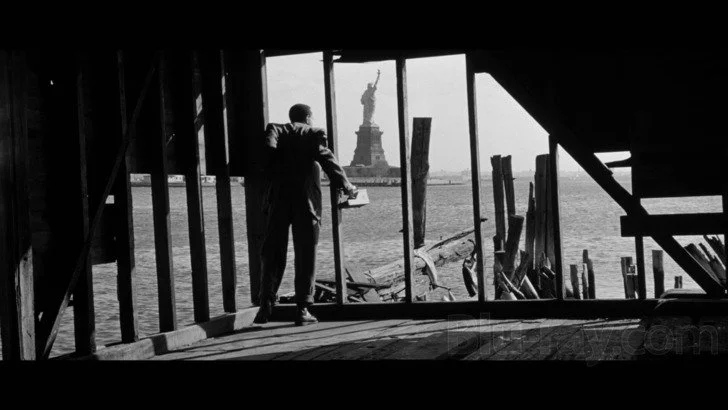
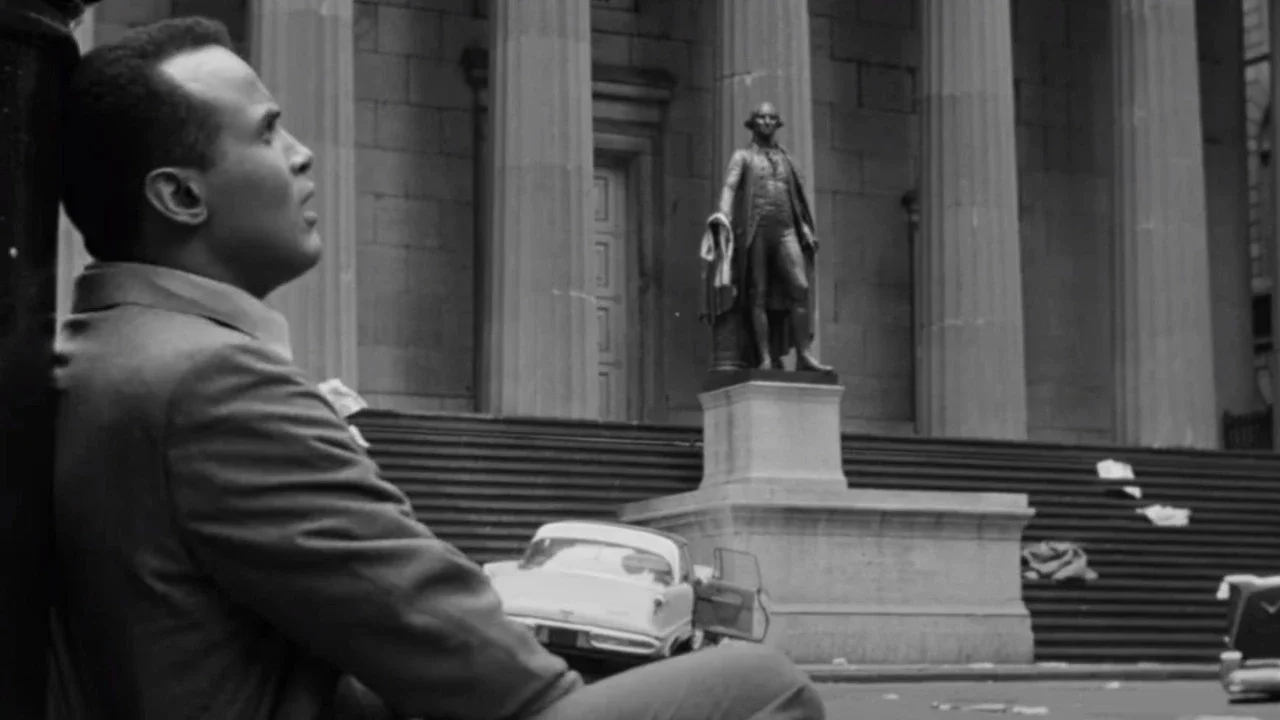
What really sells the post-apocalyptic setting is the on-location shooting around Manhattan, effectively capturing this once bustling metropolis of concrete and steel gone hauntingly still. Which begs the question: how on earth did they pull off some of these shots in a city like New York? I have read that the cast and crew filmed at dawn, preempting the morning rush, for only a few hours at a time. In some instances, these shots were nicely composited with matte paintings.
While science fiction cinema is often associated with eye-popping special effects or striking imagery, this film takes the “less is more” approach. Cinematographer Harold J. Marzorati soaks the lonely locales in and around Manhattan with his black and white photography, and the simple sound design choices—wind, rain, and the echo of footsteps against the otherwise silent city—are very stark.
A couple of minor qualms: While I understand it is a key element of this story, love triangles are not one of my favorite tropes, and this one fills much of the final third of the movie. I would have also appreciated just a tad more time spent on the science and/or geopolitics of these weapons of mass destruction.
While Belafonte and the filmmakers were hamstrung by the confines imposed on his film by societal norms of the time (a little more on this is in the next section), The World, the Flesh, and Devil still offers a lot to unpack relevant patriarchy, race, misogyny, and nuclear age anxiety. The film was released at a time when humanity might have felt as if it sat on the edge of a frightening precipice. Yet, there is a vague suggestion that a better world might be around the corner, if not in substance at least in promise.
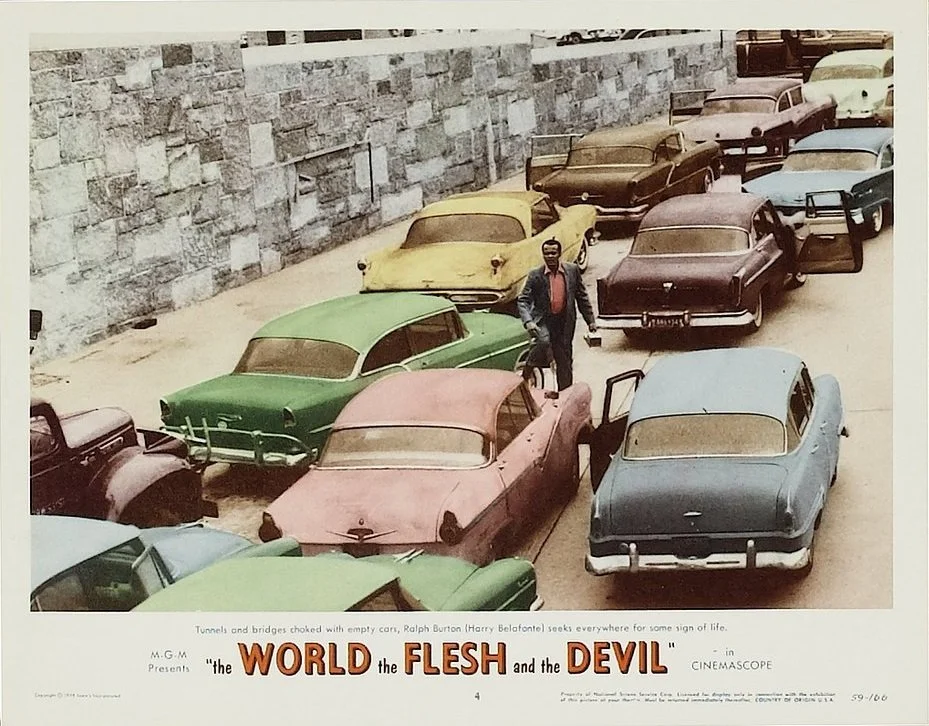
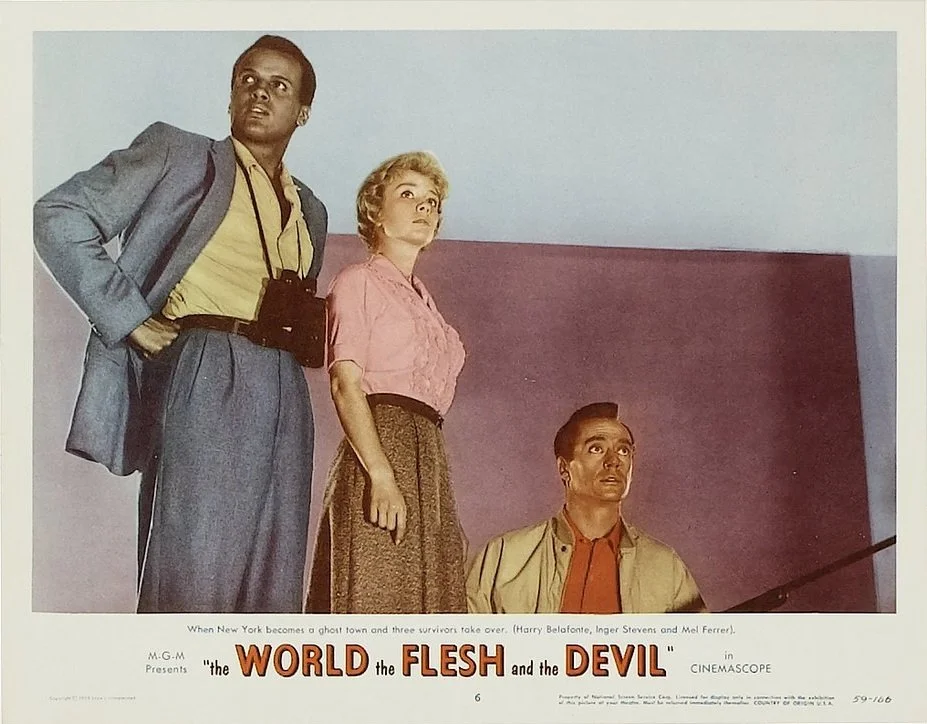
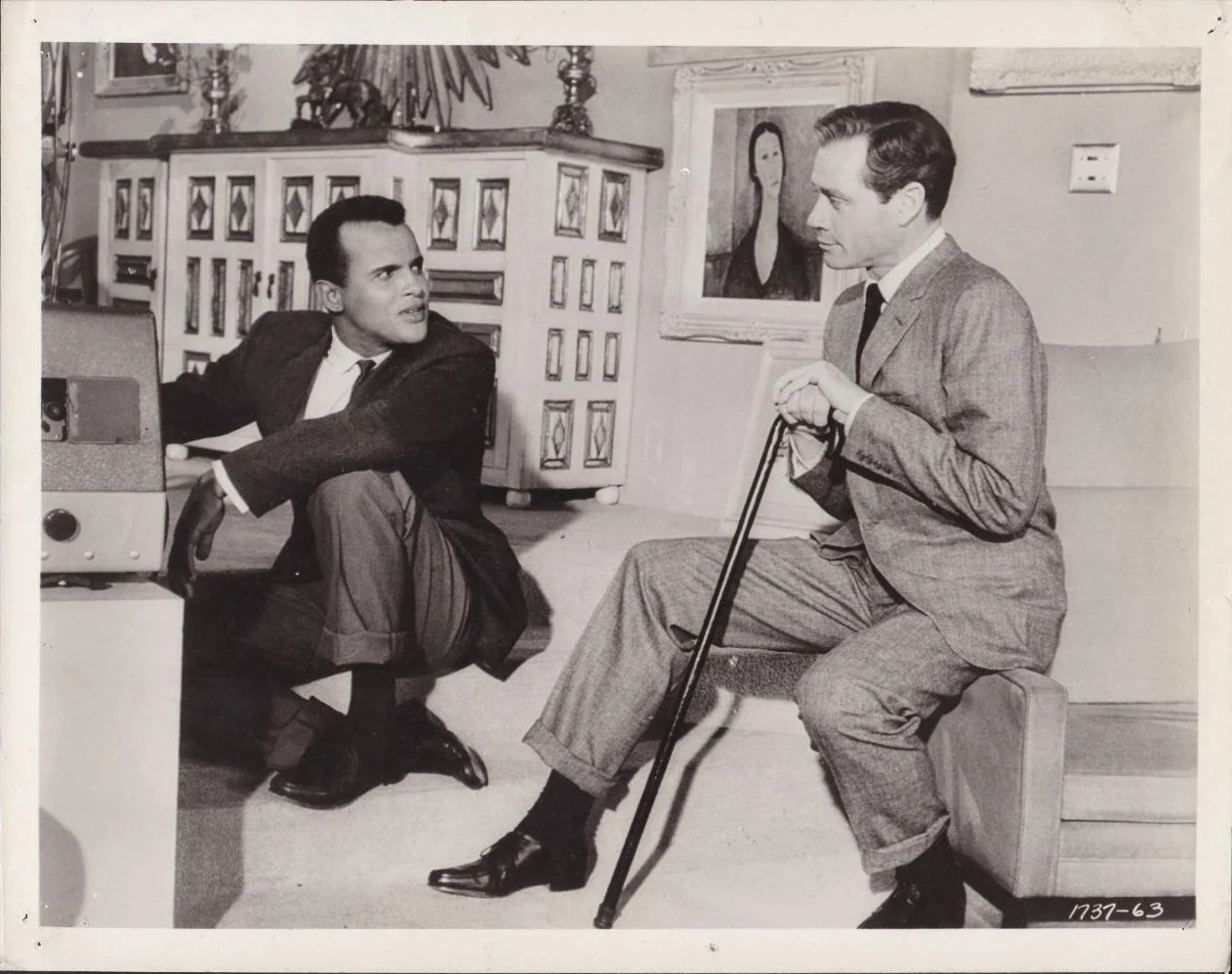
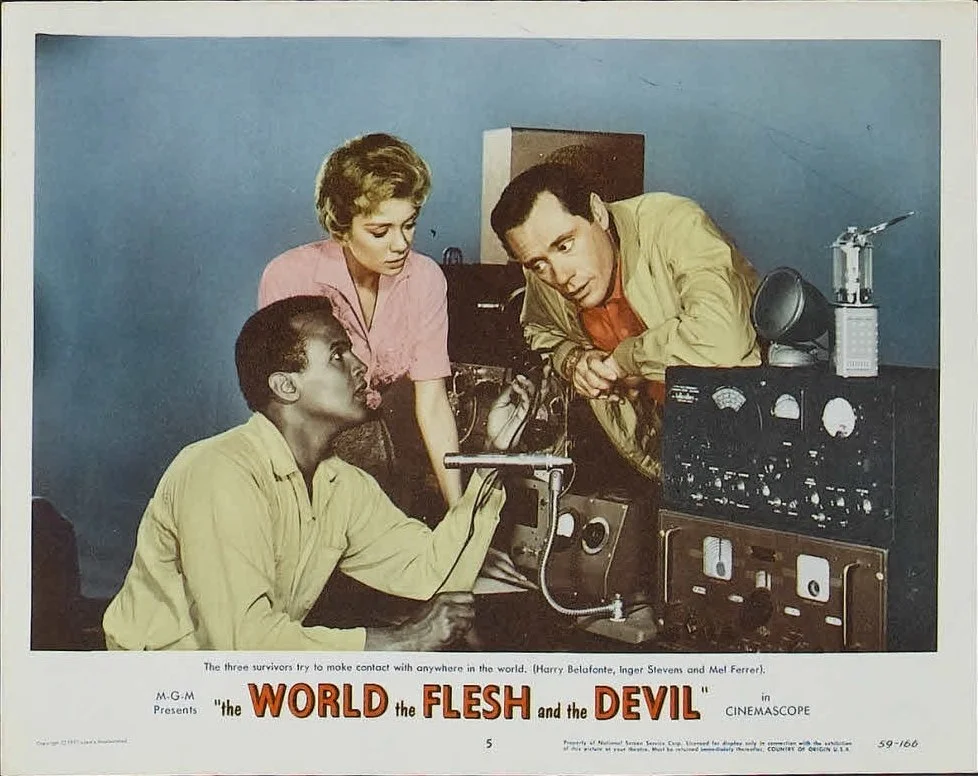
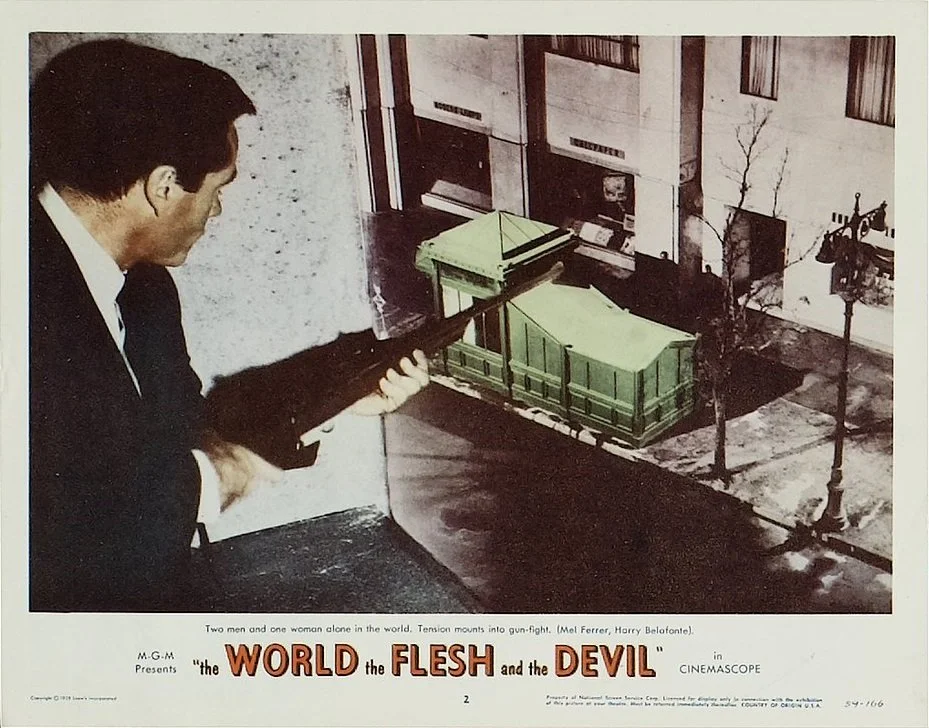
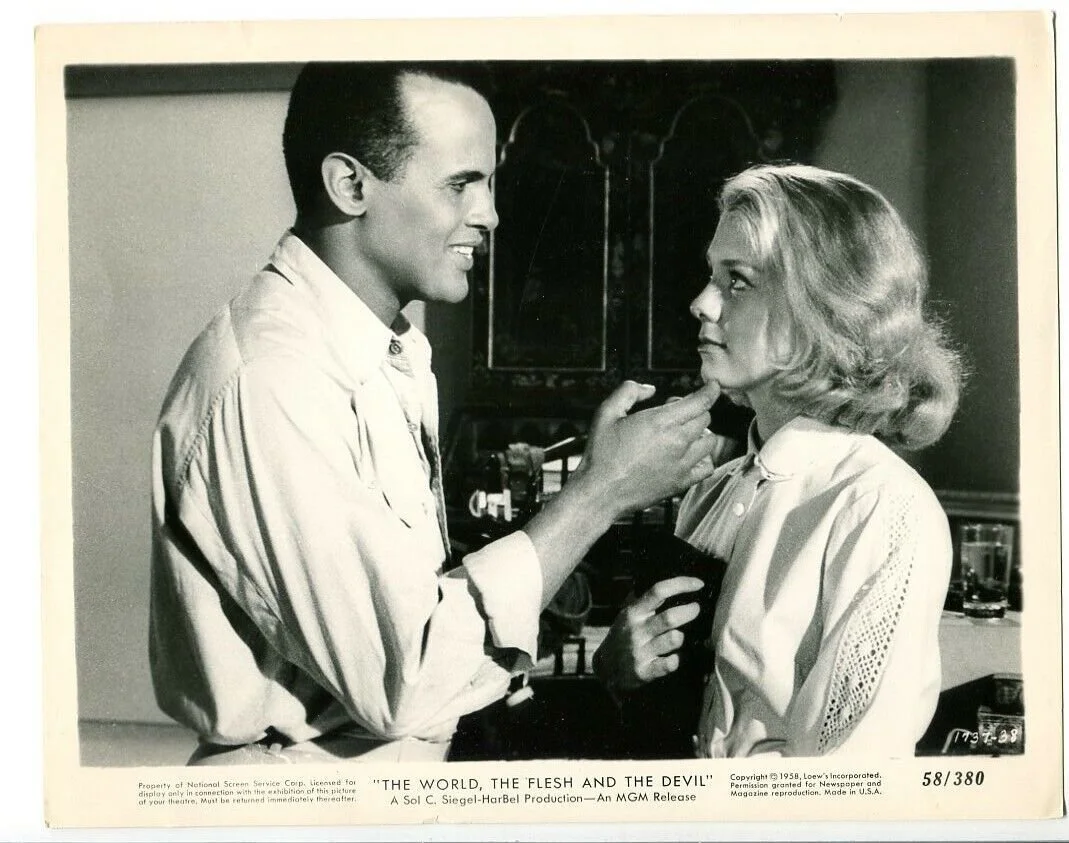
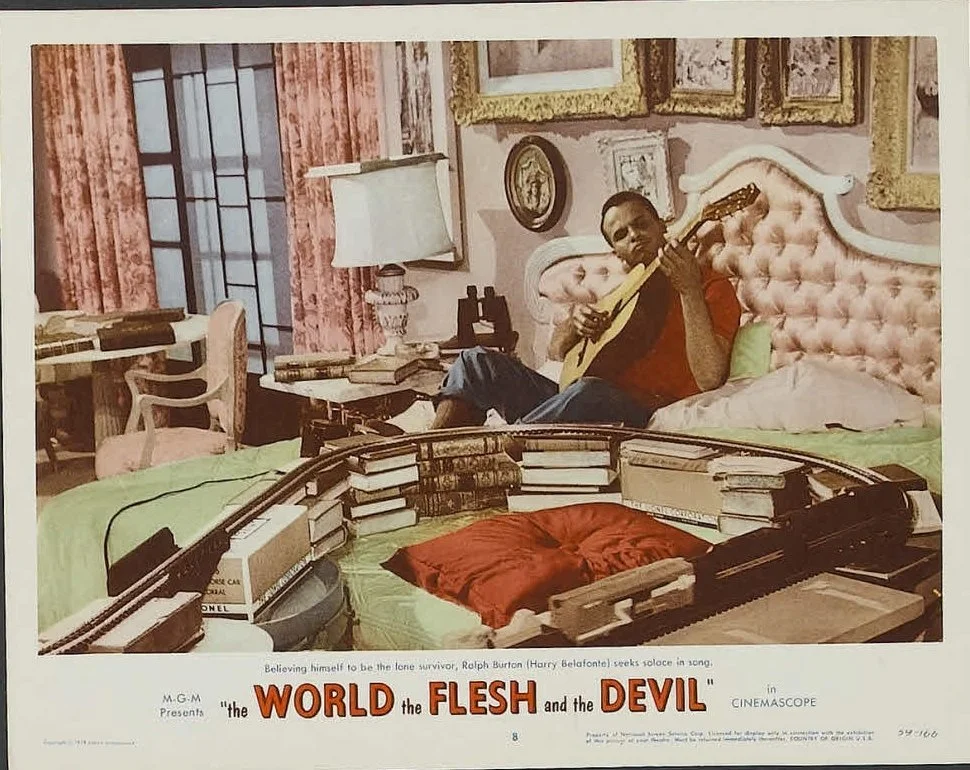
Lobby cards and publicity stills
Did you know
The World, the Flesh, and the Devil was boycotted by some theaters in the Southern U.S.
Belafonte performs several songs in the film, which are worked in fairly naturally in the narrative.
When The World, the Flesh, and the Devil was released several states still had so-called anti-miscegenation laws on the books, which barred interracial marriage. In 1967 the Supreme Court ruled that such laws were unconstitutional in the landmark Loving v. Virginia case.
The movie was based loosely on The Purple Cloud, a 1901 novel by M.P. Shiel.
Belafonte was somewhat restricted by what was permissible when it came to portrayals of interracial relationships. This included kissing his white costar, a problem he also ran into in his previous film Island in the Sun (1957) with his female lead Joan Fontaine. For The World, the Flesh, and the Devil, Belafonte pushed back against this type of resistance from co-producer Sol Siegel and was supported with equally impassioned protests from costars Inger Stevens and Mel Ferrer, though they were unsuccessful.
The film was released the same year as the debut of The Twilight Zone and one could argue it would work quite well as an episode of that groundbreaking series.
The Swedish-born Inger Stevens had a successful acting career but her personal life was purportedly strained by intense and ill-advised relationships with costars and mental health struggles, including several suicide attempts. She died of an overdose in 1970 at the young age of 35.
Early in the film Ralph befriends a couple of mannequins he names Betsy and Snodgrass. This is reminiscent of other films (notably I am Legend and Castaway) where characters befriend inanimate objects to stave off loneliness and preserve their sanity.
Inger Stevens played Nan Adams in the often celebrated episode of The Twilight Zone called “The Hitchhiker.”
Belafonte created his own production company (Harbel Productions, Inc.) with the purpose of producing films to ensure greater representation in Hollywood. The short-lived venture yielded only two films, The World, the Flesh and the Devil and Odd Against Tomorrow, a solid noir starring Belafonte and Robert Ryan.
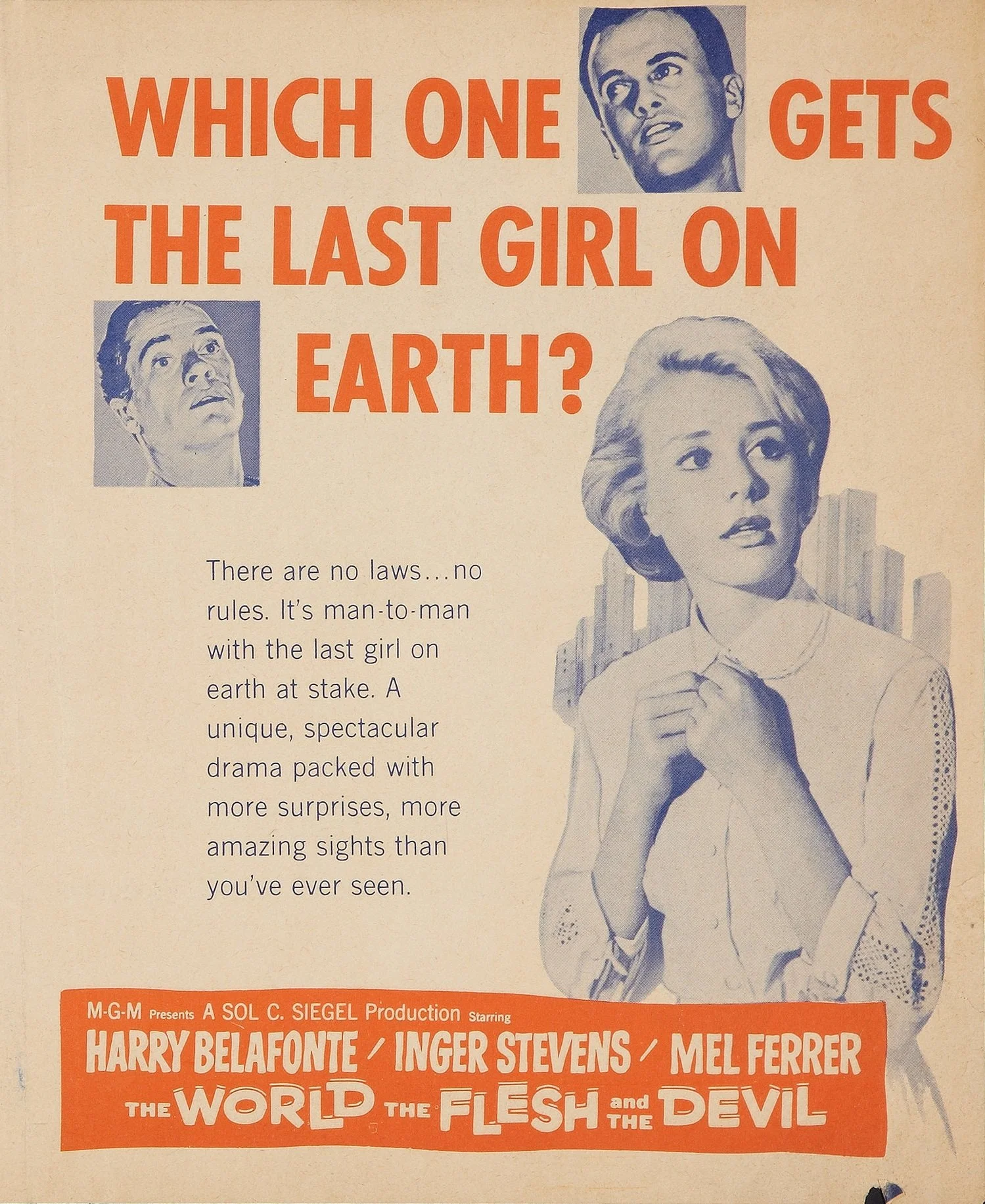
Original promotional art
How did I watch?
Streaming Google Play
Cast
Harry Belafonte – Ralph Burton
Inger Stevens – Sarah Crandall
Mel Ferrer – Benson Thacker
Crew (abridged)
Director – Ranald MacDougall
Writer – Ronald MacDougall
Cinematography: Harold J. Marzorati
Music – Miklos Rozsa
Art Direction: Paul Groesse, William A. Horning
Production Designers – William A Horning, Paul Groesse
Production Companies – Sol C. Siegel Productions, Inc., Harbel Productions, Inc., Metro-Goldwyn-Mayer Corp. (Loew's Inc.)
Running Time: 1h 34m
Recommendations based on The World the Flesh and The Devil-
On the Beach (1959)
Odd Against Tomorrow (1959)
Panic in the Year Zero! (1962)
The Last Man on Earth (1964)
The Quiet Earth (1985)
Supplements-
Harry Belafonte, Actor, Activist (Smithsonian)
The World, the Flesh, and the Devil: Race and the Apocalypse (Sloan Science & Film, MOMI)
Harry Belafonte: 10 Essential Performaces (BFI)