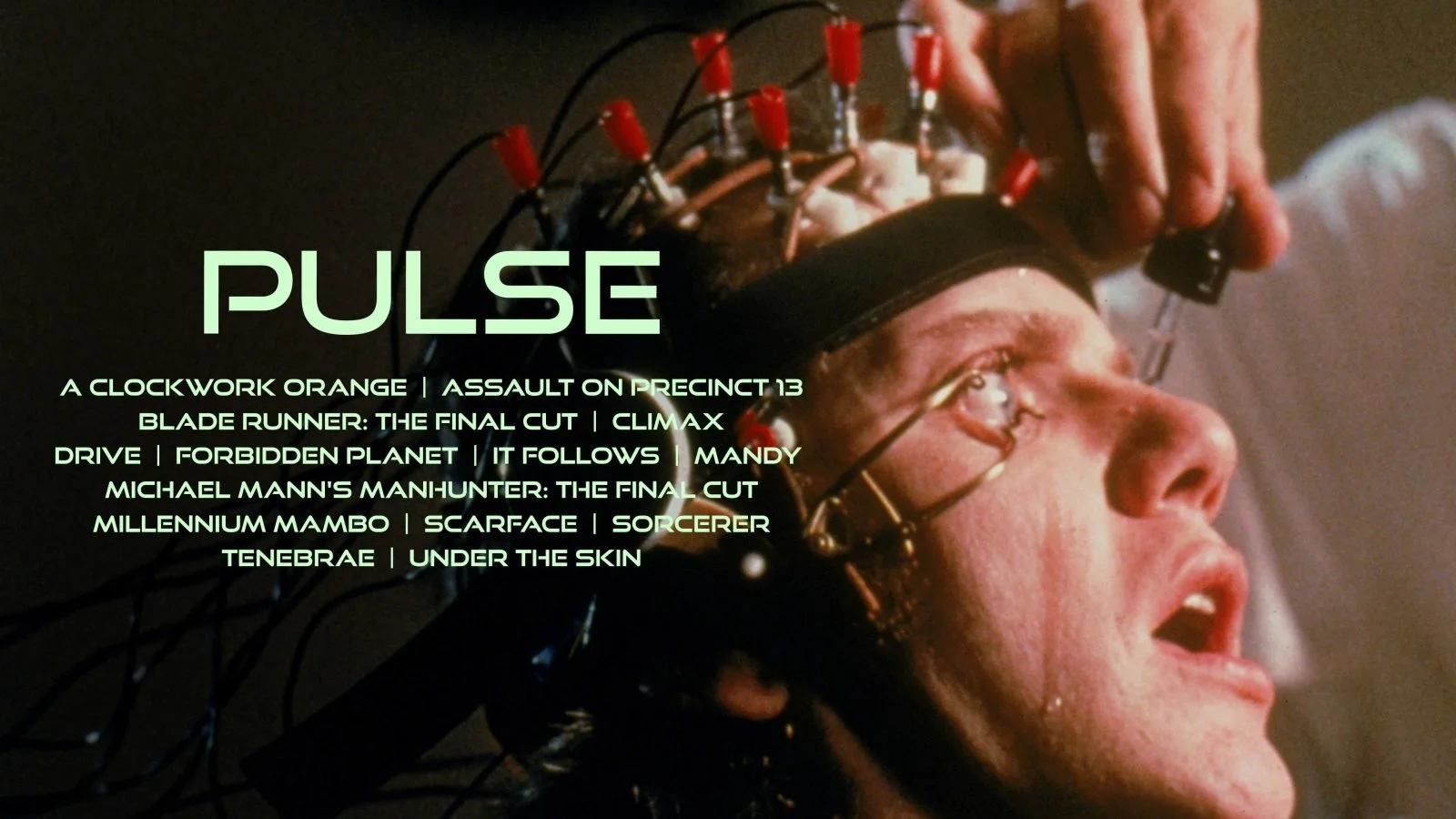
Promotional image for Metrograph’s Pulse

To our NYC-area moviegoers with an ear for the pulsing and electrifying music of genre cinema: Metrograph is curating Pulse, a series dedicated to those atmospheric, ambient, and unforgettable tracks and “electronic tonalities” (more on that down below) that complement some of our favorite films. Thanksgiving may have just passed but I spot few turkeys in this bunch.
The series includes more than a dozen movies enhanced by evocative all-electronic or hybrid scores that are not only a blast to listen to on their own but are also essential, even indispensable, elements of the movies they are attached to. Below is a quick and dirty rundown of just a few of these titles. Read up, listen in, and enjoy!
A Clockwork Orange (1971)
Stanley Kubrick’s committed cinematic take on Anthony Burgess’s 1962 dystopian sci-fi novel is the stuff of controversial cult film lore. A Clockwork Orange is a visceral and stylized portrait of hyper hooliganism, societal decay, and youth’s obsession with “ultra-violence.” The music reflects Kubrick’s penchant for including classical pieces augmented by symphonic twists. The film also features composer Wendy Carlos’s unique electronic score, which makes good use of a Moog modular synthesizer. Her score saturates the film with a cold and damp chill and sets down a heavy fog to match the depravity and totalitarianism of dreary London. I discovered this film in my college days, which prompted quite a few screenings with friends and listening sessions on CD. It has since lost little of its potency.
Under the Skin (2013)
This one is unlike any other science fiction film I have seen, which is saying something. The story follows an extraterrestrial seductress whose mission is to ensure that select Scottish men become grist for the alien mill; if that sounds weird and opaque it’s because it is. The (literally) dark and surreal “harvesting” sequences are better seen than described. English Composer Micaela Rachel Levi’s minimalist and insidious score is a perfect complement to the unsettling yet absorbing imagery and ideas put forth by director Jonathan Glazer. Levi employs synthesizer, percussion, and digital manipulation of strings to mesmerizing effect, culminating in a soundscape that slithers its way slowly up your spine and into your ears. This is an off-kilter and ominous score that at times feels totally alien, and at others all too human.
Tenebrae (1982)
Tenebrae is a meta Giallo from Italian auteur Dario Argento, a familiar name to those with an affinity for European horror. This is a psychosexual tale with a jagged edge—a contrast to the straight razor wielded by the movie’s mysterious killer. Argento purportedly convinced former Goblin frontman and keyboardist Claudio Simonetti and a couple of his former bandmates to create the score for Tenebrae. And why not? The progressive rockers recorded killer scores for some of Argento’s greatest films, including Deep Red (1975) and Suspiria (1977). Goblin was known for jazz/funk/rock straddling arrangements, sudden mid-track pivots, chants, all manner of percussion (love those tubular bells), and liberal use of the Moog synthesizer. The standout track is Tenebrae’s main theme, a real banger featuring percussive flourishes, keyboards, distorted vocals, bass, and guitar.
Forbidden Planet (1956)
A loose retelling of Shakespeare’s The Tempest, Forbidden Planet is a seminal science fiction film for many reasons, not the least of which is its pioneering score with buzzing, pinging, bubbling, whirring, popping, bleeping, and eerie reverberations that no doubt entranced early listeners of this first-ever entirely electronic score for a commercial film. While this was a prestige MGM production, the studio took a chance on the music with avant-garde composers Louis and Bebe Barron. It was an inspired choice, as the atonal and other worldly compositions continue to inspire fans and filmmakers 70 years since the film’s initial release. While the original credits stated “electronic music by Louis and Bebe Barron,” the wording was ultimately changed to say “electronic tonalities” as the term “music” was objected to by the American Federation of Musicians, of which the Barrons were not members. Their contribution to the film was subsequently not considered for best musical score at the Oscars.
Manhunter (1986)
Michael Mann’s superb thriller is a must see for fans of serial killer crime procedurals and aspiring Mann completists. It is also notable as it features the fictional Hannibal Lecter four years before Silence of the Lambs (1990). Manhunter has several hallmarks of the director, including a charged, stylish, and precise brand of storytelling, a distinct reveling in nighttime photography (no one quite captures the night like a Mann production), and a highly evocative electronic/rock-infused score. One might be forgiven for thinking Mann hired Tangerine Dream for Manhunter as he did for his audacious directorial debut Thief (1981). Instead, Mann used several artists including Shriekback, composer Michel Rubini, and The Reds. The latter’s synth and guitar-saturated sound infuses several nighttime sequences with their own intoxicating energy. The Reds collaborated with Mann on other projects including the Miami Vice TV series and the film Band of the Hand (1986), which the filmmaker produced.
It Follows (2014)
One of several breakout films in an excellent decade for horror, It Follows features a fantastic score—rhythmic and often relentless—as the specter of a painful death terrorizes those caught up in the supernatural cycle at the heart of this story. A shapeshifting entity stalks and kills young people and the only way out is to sleep with someone to pass on the death curse. Musician/composer Disasterpeace (the stage name for Richard Vreeland) gives us a pounding score that alternates between high-pitch metallic beats and a deep bass rumble with overlapping distortion that is powerful, inevitable, and unknowable. Hardly one note, the score offers moments to breathe with ethereal and ambient pieces that evoke more wonder than dread. I don’t think it’s a stretch to suggest that the driving, pulsing components of the score were inspired by some of the iconic 1970s and 1980s films of John Carpenter. That is hardly a bad thing.
Blade Runner (1982)
Near-perfect bioengineered synthetic human replicants go rogue in a quest for more life in a distant (at the time) 2019. The setting is an acid rain-drenched, smog-shrouded, and neon-studded Los Angeles on a planet Earth that is in environmental peril. Here retired blade runner Rick Deckard is charged with tracking down and eliminating the fugitive (and very dangerous) replicants. Composer Vangelis used a variety of synthesizers for this foundational sci-fi score, most famously his Yamaha CS-80, plus other electronic and acoustic instruments. The score is suggestive of classic noir, jazz, and new-age mysticism, with some vaguely eastern musical cues added for good measure. The version of Bladerunner screened at Metrograph is the “final cut” of the film, said to be director Ridley Scott’s definitive version.
Assault on Precinct 13 (1976)
This is a Concentric Cinema favorite and the subject of an upcoming Cinematic Semicentennial Series feature. Therefore, we will show some restraint and defer our gushing about this John Carpenter-directed classic: a siege movie with swagger, heart, and a no small amount of charming gallows humor. The synth-heavy score by Carpenter and musical collaborator Alan Howarth is unfussy and muscular, delivering its signature themes boldly and confidently. I had the pleasure of attending a concert at the Knockdown Center in Queens in the fall of 2025, which featured Carpenter, his son Cody, and Daniel Davies, backed by a full band performing the music for some of the revered director’s best sci-fi and horror films. Check out The King of Horror Comes to Queens to learn how it all went down.
If this rundown piqued your interest (or pricked your ears) be sure to check out Pulse today! Visit the series’ landing page for more information, including dates and showtimes. Note: New screenings continue to be added, so be sure to check back for updates.
Metrograph, an independent company founded in 2016, is in Manhattan’s Lower East Side on 7 Ludlow Street. The nearest subway stops are via East Broadway on the F line or Grand Street off the B & D. Visit Metrograph.com to learn more about the extensive and eclectic cinematic programing, along with The Commissary at Metrograph, a full-service restaurant that draws its inspiration from Hollywood’s Golden Age.
Last, learn about the advantages of getting a membership, including discounts on tickets, the restaurant, and bookstore.
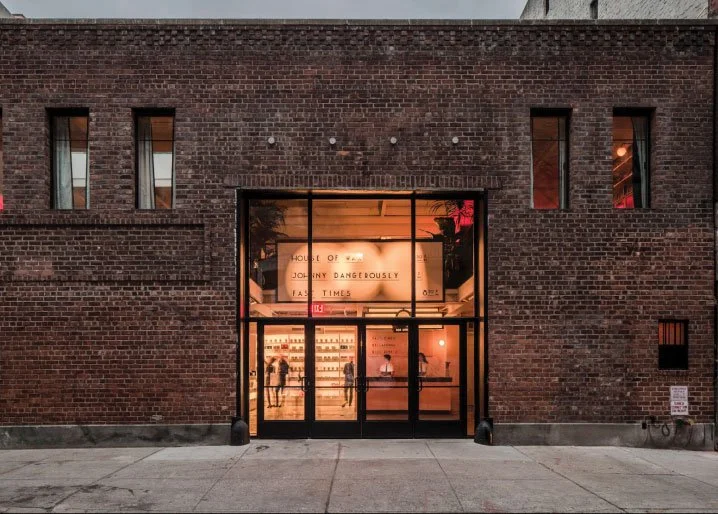
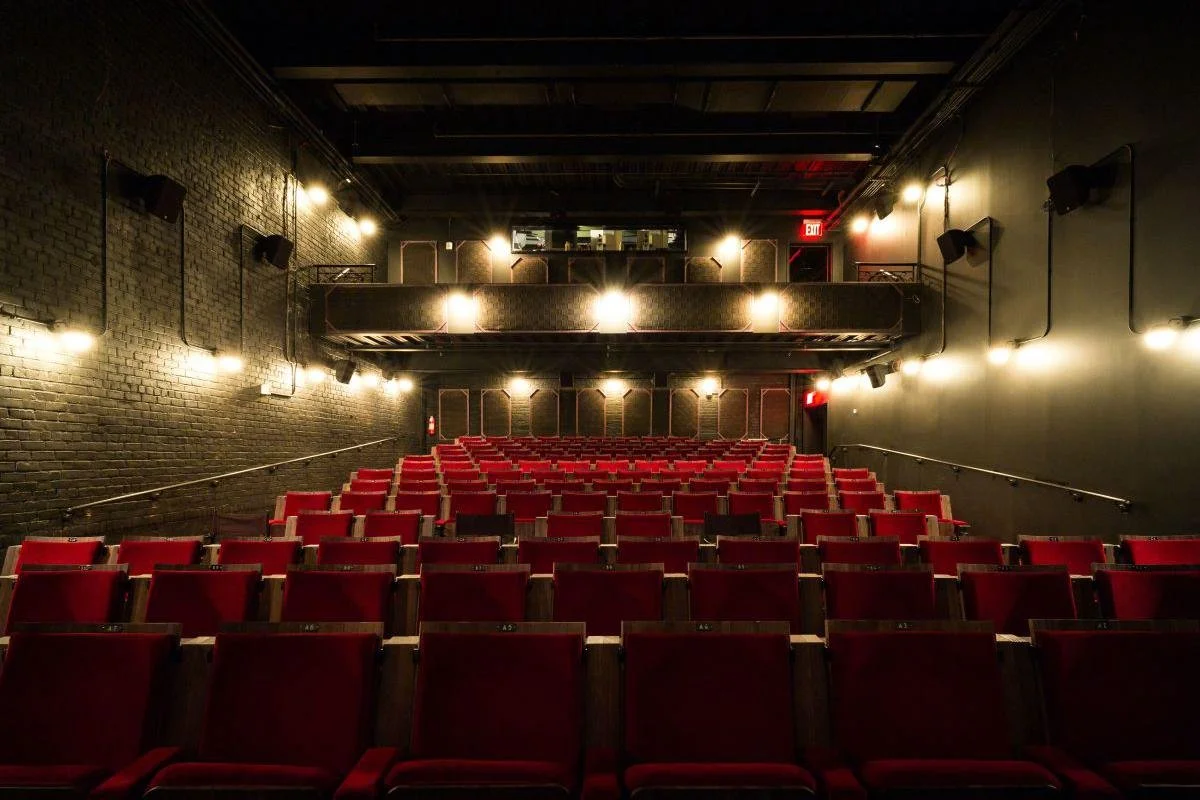
The exterior and interior theater of Metrograph on 7 Ludlow Street.
Next Up - After a quite long hiatus from horror, we return to one of our favorite genres through a very subjective and idiosyncratic lens.